6 ways to protect personal information online
Internet and Network

6 ways to protect personal information online

In today’s digital space, maintaining privacy requires a well-thought-out, proactive strategy. Personal data has become a valuable commodity for advertisers, and it’s a significant target for cybercriminals. Therefore, it’s important to know how to protect personal data. By intentionally hiding personal information online, one can significantly reduce their digital footprint and enhance their overall security. The need to research and design a roadmap to navigate the internet while keeping private details out of prying eyes cannot be overstated. Avoid using free Wi-Fi Public places like airports, cafes, and hotels with public Wi-Fi are convenient spots to get some work done. But they are also notoriously insecure. Public networks often lack robust encryption, making a hacker’s job easier. It allows unauthorized parties to view login credentials, private messages, and credit card numbers in real time. To avoid sharing personal data online when traveling, it is best to avoid accessing unreliable public networks. If it is necessary to connect, using a VPN is a critical step to create an encrypted tunnel for data and keep the information unreadable for unethical use. Avoid oversharing on social networks Social media platforms are a gold mine for individuals planning identity theft. Many social media users can unknowingly provide the building blocks for identity theft prevention by posting birthdates, locations, and personal life details.

Common cybersecurity threats and best practices to protect data
Internet and Network

Common cybersecurity threats and best practices to protect data

Cyber threats continue to evolve faster than ever, and individuals and organizations are constantly at risk from malware, phishing, and AI-driven attacks. According to a study, global cybercrime costs are expected to reach $13.82 trillion by 2028. As such attacks become more sophisticated and harder to detect, knowing how they work and following cybersecurity best practices can safeguard the digital assets of individuals and organizations from their after-effects. Digital security threats Malware Malware is malicious software that compromises a user’s systems. Cybercriminals create malware to render systems or applications unusable. They also extract sensitive and confidential information from individuals and businesses. Once that information is taken, it can be used for nefarious purposes, such as wiping clean bank accounts, executing real-world security breaches and attacks, and destabilizing law enforcement operations.  Malware takes many forms, such as viruses, worms, trojans, spyware, bots, ransomware, adware, rootkits, and keyloggers. Social engineering It is a manipulation technique wherein individuals are tricked into sharing confidential information. Cybercriminals, or their enablers, execute a social engineering attack by gaining the trust of those who hold critical information. Essentially, social engineering is a trust-breaching con job. For instance, at an organizational level, cybercriminals may gain an employee’s trust to obtain information.  This is also one of those digital security threats that involves impersonating a legitimate entity to gain access to a secure server and its information.

Popular Reads

Top 6 AT&T bundles to consider

Top 6 AT&T bundles to consider

AT&T’s DIRECTV + Internet 300 bundles are a good choice for those with varied entertainment preferences. Additionally, their internet speeds are reliable, and each package comes with a diverse yet tailored TV lineup. What’s more, some options also include unlimited home phone service for added convenience. Each AT&T TV and internet bundle is affordable and offers something unique to its viewers. Knowing the popular options available in the market can help buyers choose the one that best fits their requirements. DIRECTV ENTERTAINMENT + INTERNET 300 bundle This entry-level AT&T cable and broadband bundle is designed keeping affordability and leisure consumption in mind. It pairs AT&T’s Internet 300 speeds with a streamlined TV lineup featuring 90+ channels, including news, kids’ programs, and lifestyle networks. This plan costs about $145 per month, plus fees, with a 2-year lock-in period on the TV bundle. This scheme is suitable for those who prefer staggered payments. The DIRECTV ENTERTAINMENT + INTERNET 300 package is a good option for those who require basic entertainment, reliable internet, and a simple, no-frills setup. DIRECTV CHOICE™ Package + INTERNET 300 This is a mid-tier option that is affordable yet offers a rich channel mix. That said, it does primarily focus on live events and sports.
Top telecom carriers and things to consider before choosing them

Top telecom carriers and things to consider before choosing them

The kind of experience a person has when using their cell phone depends on which phone carrier’s services they use. That’s why choosing the right carrier is important. To decide which provider is the most suitable, it helps to consider factors like internet speed, long-term contracts, customer service, and cost. Coverage strength and plan flexibility also play a key role in determining the overall experience. Comparing popular providers based on these factors helps customers make better decisions. Popular mobile network providers in the US  T-Mobile With 5G coverage to over 330 million people, T-Mobile has one of the widest networks. Its median download speed is around 274.4 Mbps, which is sufficient for users to stream 4K content, handle large file transfers, and support multiple devices simultaneously without buffering or lag. The carrier’s plans include: Essentials, which offers 50GB of premium data for around $90 per month Experience More, which costs $140 per month and comes with 60GB hotspot and a Netflix Standard subscription  Experience Beyond, which offers unlimited talk & text and up to 30GB high-speed data in Canada & Mexico for $170 per month Customers who want modern 5G and inclusive benefits at non-premium prices will find these plans appealing.
5 no-contract carrier plans to consider

5 no-contract carrier plans to consider

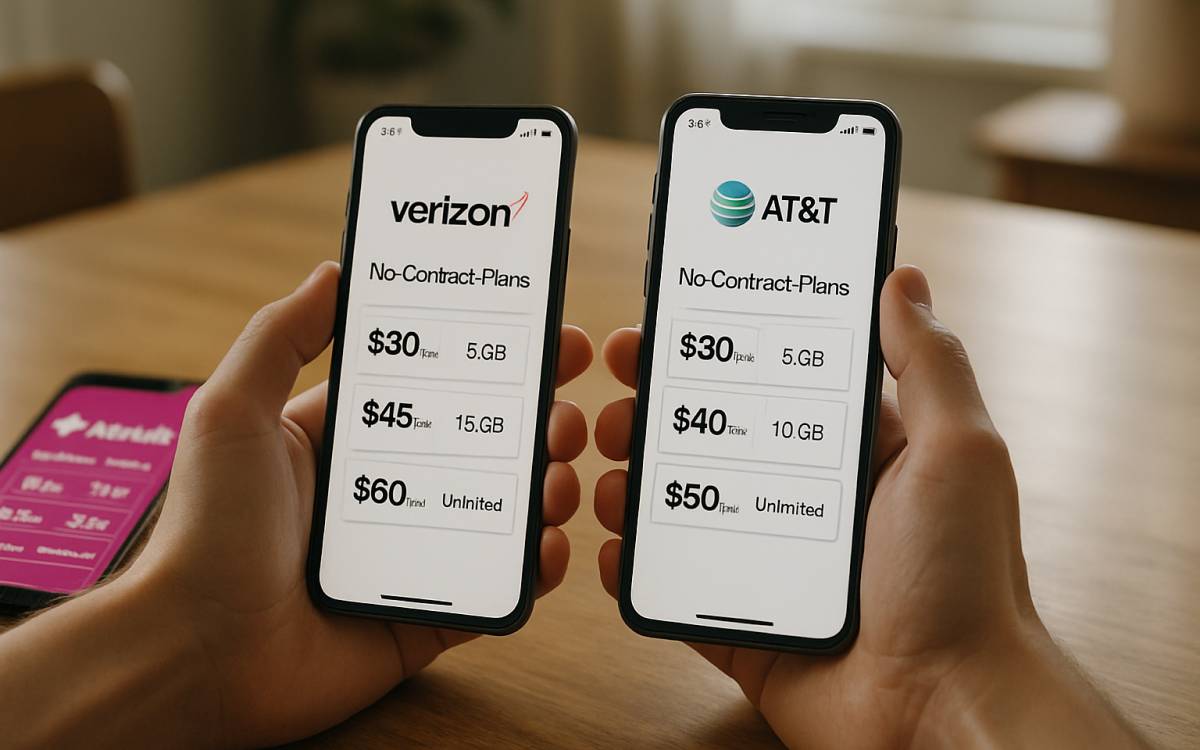
Network carriers provide a variety of mobile plans to suit different users. This includes options for those who prefer no-contract plans, even if they cost slightly more. While many top prepaid plans require no contract, not all are the same. Each plan offers a unique set of benefits, such as calling minutes, text messages, and data allowances. Learning about these differences can help one make a more informed choice when selecting a plan. US Mobile’s Unlimited Flex plan – Affordable for a single line The plan comes with 10 GB of high-speed data, followed by unlimited data at reduced speeds. Users also get 5 GB of hotspot data. The Unlimited Flex Plan also supports international calling and texting within the nation, with optional roaming add-ons while traveling. In terms of pricing, users can get this no-contract mobile deal for about $17 per month with an annual purchase (or $25 per month), making it a budget-friendly option for those with light data needs. Google Fi Unlimited Standard – For multiple lines Families seeking an affordable, no-contract cell plan that is also reliable can consider the Unlimited Standard plan from Google. This plan includes unlimited data, calls, and texts, with 50 GB of high-speed data.